Introduction
Flxpoint is designed to manage product data across suppliers, internal systems, and sales channels through a structured lifecycle. At the core of this system is the concept of “Flow”, which defines how product data moves within the platform.
There are three key stages of product management:
- Source Inventory – Raw product data from suppliers or warehouses
- Product Catalog – Centralized, merged, and enriched product data
- Channel Listings – Sales-channel-specific product listings
The way data moves between these stages defines your Flxpoint Flow.
Understanding Flxpoint Flows
Flxpoint supports two primary workflows:
Left to Right Flow
Source Inventory → Product Catalog → Channel Listings
Right to Left Flow
Channel Listings → Product Catalog → Source Inventory
These flows represent different business approaches depending on whether your operations are supplier-driven or channel-driven.
Left to Right Flow (Supplier → Channel)
Overview
The Left to Right Flow begins with supplier data and builds toward sales channels. It is the most structured and scalable approach.
- Import inventory from suppliers
- Merge and enrich data in Product Catalog
- Publish or sync listings to sales channels
Product Lifecycle
- Import data into Source Inventory
- Merge and enhance in Product Catalog
- Create and publish Channel Listings

Example
A product like a “Best Dad coffee mug” may exist in multiple supplier sources:
- Each supplier version = Source Inventory
- Merged into one product = Product Catalog
- Published to multiple platforms (Shopify, Magento, etc.) = Channel Listings
Step-by-Step Process (10 Steps)
- Integrate sources and sales channels
- Import inventory data
- Validate source inventory
- Select inventory for catalog
- Build product catalog
- Customize and validate product data
- Create listings per channel
- Customize listings per channel
- Publish or link listings
- Sync pricing, quantity, and updates
Recommended Use Cases
Choose Left to Right if:
- You are a new business without an established channel
- You are migrating to a new platform
- You want to rely on supplier data as the source of truth
- You want to standardize product data first
- Your supplier data includes identifiers (UPC, MPN, GTIN)
Right to Left Flow (Channel → Supplier)
Overview
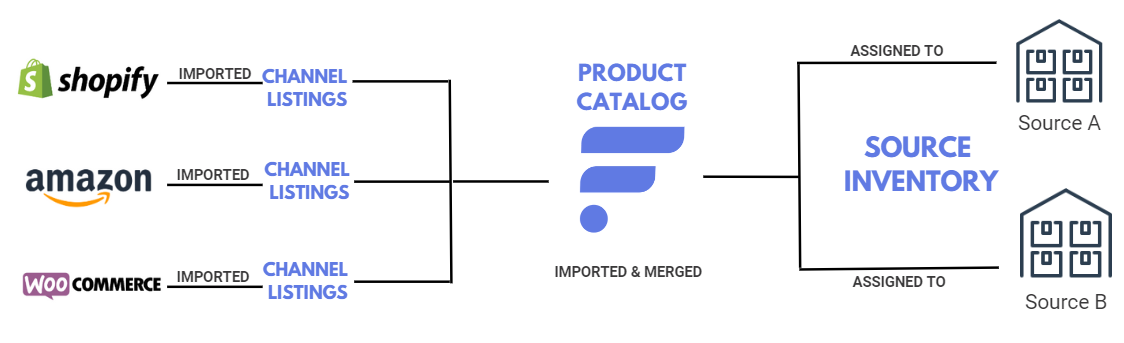
The Right to Left Flow starts from your sales channel and works backward to suppliers.
- Import listings from sales channels
- Merge into Product Catalog
- Assign suppliers for fulfillment
Product Lifecycle
- Import products from Channel Listings
- Merge into Product Catalog
- Assign products to Source Inventory (Suppliers)
Key Concepts
- Channel Listings = Sales-channel-specific product versions
- Product Catalog = Central merged product data
- Source Inventory = Fulfillment sources (suppliers/warehouses)
Recommended Use Cases
Choose Right to Left if:
- You already have an existing sales channel
- You use custom or enriched product data
- You want a quick onboarding and faster testing
- Product data management is not a priority initially
- You are migrating from another inventory system
Key Differences Between Flows
Choosing the Right Flow
Choose Left to Right if:
- You want clean, standardized product data
- You are building your catalog from scratch
- You prioritize data quality and scalability
Choose Right to Left if:
- You already have live listings
- You want speed over structure initially
- You plan to optimize data later
Best Practices
- Start with a clear data ownership strategy (supplier vs channel)
- Ensure consistent identifiers (UPC, SKU, etc.)
- Test with a small product set first
- Use automation for syncing and updates
- Gradually scale once the workflow is validated
Conclusion
Flxpoint’s flexibility lies in its ability to support both supplier-first and channel-first workflows.
- Left to Right Flow ensures structured, scalable operations
- Right to Left Flow enables rapid onboarding and quick go-live
Choosing the correct flow depends on your business maturity, data readiness, and operational priorities.